
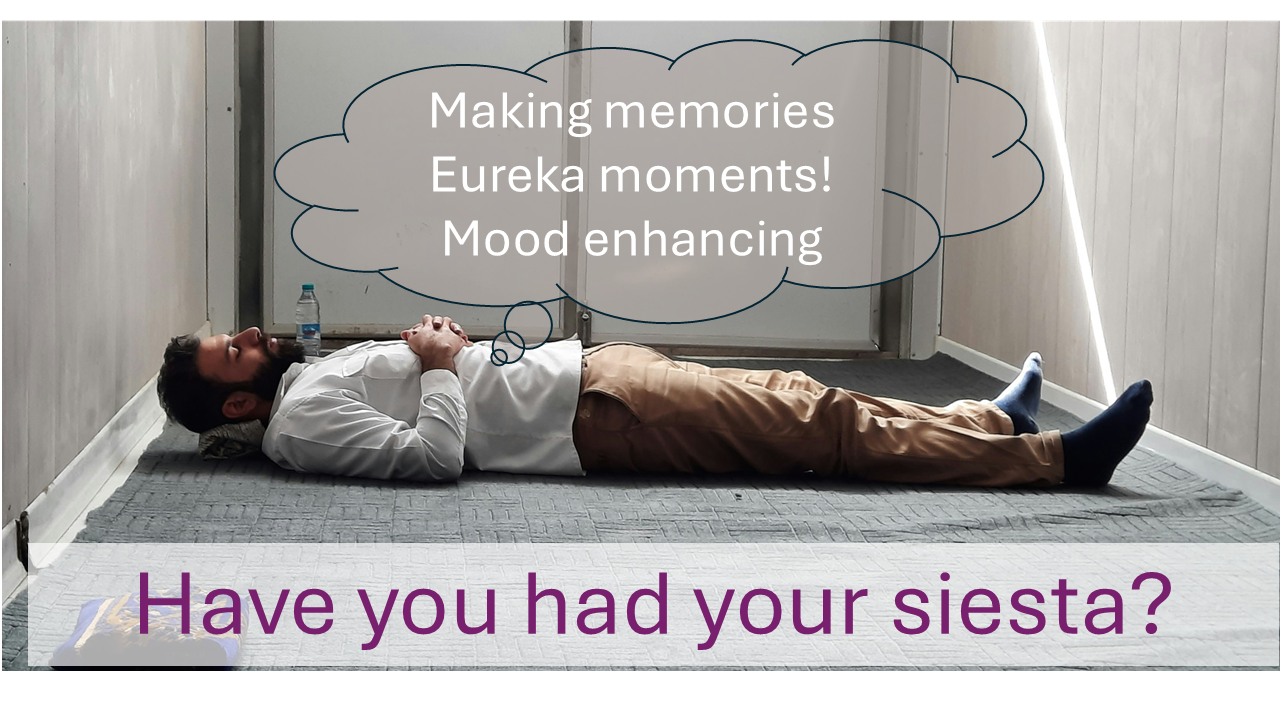
 Trying to work during a heatwave will reduce productivity for many people.
To counterbalance this, other than hydration and staying cool, a great solution is to take a siesta.
“Siesta” is a Spanish word, derived from a Latin phrase referring to the ‘sixth hour’, counting from dawn taking your to ‘midday rest’. A siesta is when you take a short nap during the day. As heat makes working difficult, the afternoon is a perfect time for a short nap.
Studies have shown an afternoon nap can give you a real boost. Especially, relating to work and productivity, here are some of the reasons why you might want to build a siesta into your working day:
- Memory improvements
- Mood boosting – feel refreshed and more resilient after a nap of no more than 30 mins
- Productivity is increased – you will be 2.3% more productive on the day, and naps will boost your overall sleep count (enhancing immunity and general health)
- Reduce errors
- Huge boost in inspiration
Here is some of the science:
- Laying down (fully) takes gravity out of the equation, immediately relieving the brain of this deceptively taxing task
- Closing your eyes immediately changes your brain waves, boosting relaxing and restful alpha brain waves
- Our two little memory banks (hippocampi) are ‘emptied’ during a nap, and these memories integrated more permanently into other parts of brain. This leaves the hippocampi free to fill up again.
- 85.7% of participants in a 2025 study found that they gained inspiration and insight after a nap – so a siesta is great way to solve problems!
Some tips for getting the most out of your siesta:
- Only take a siesta for 10-30minutes max (any longer and you will experience grogginess)
- Don’t worry if you don’t fall asleep, even eyes shut, laying down can be a boost
- To aid falling asleep, use soporific scents such as lavender or hops for added relaxation and calming
- Upon waking, a spritz of a zesty or ‘wake-up’ scent, such as lemon or lime or peppermint can increase alertness.
- Upon waking – gain exposure to daylight (and a nice view if you can too) – letting your brain (pineal gland) gain the information (light stimulation) it needs to keep your circadian rhythm (sleep-wake cycle) on track.
- For an added bonus with the natural light exposure, look at a nice view too, as this combination has been shown to raise cognitive abilities by 42%!
References:
Sleep, productivity and exposure to natural light and views https://pubmed.ncbi.nlm.nih.gov/32384634/
Cognitive functioning reduction during a heatwave https://pubmed.ncbi.nlm.nih.gov/29990359/
Eyes closed boosts alpha brainwaves https://www.nature.com/articles/s41598-022-05289-6
Brains process information differently when lying down https://www.psypost.org/our-brains-process-information-differently-when-were-standing-up-versus-lying-down/
Fully laid down makes falling asleep easier https://www.sciencedirect.com/science/article/abs/pii/S1388245799002898
Economics of siestas – https://academic.oup.com/qje/article-abstract/136/3/1887/6217436?redirectedFrom=fulltext
Sleep sparks inspiration – https://english.elpais.com/health/2025-06-27/science-suggests-sleep-can-spark-inspiration.html
Neuroplasticity Therapies.
Discover the wide range of sensory, balance, movement, lifestyle therapies incorporated under neuroplasticity therapies.


